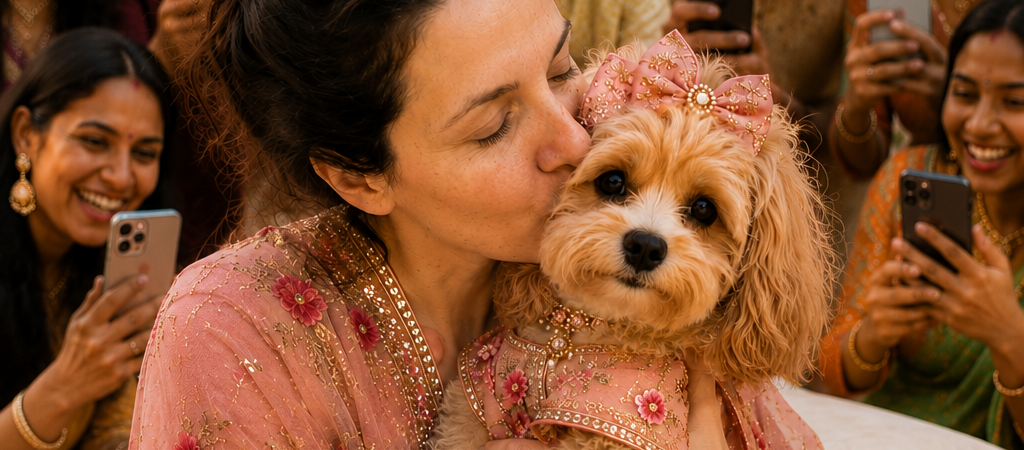
Being invited to an Indian wedding is one of the greatest honors of my travels.
It happened the way these things do: a conversation with a shop owner in Jaipur turned into chai, chai turned into meeting her family, and two days later I was being handed an invitation card thicker than my passport and told, not asked, that I was coming. In India, a wedding guest list is less a list and more a gravitational field. You get pulled in.
A celebration measured in days, not hours
A traditional Indian wedding is not one event. It is a festival with a marriage in the middle. The one I attended ran three days, and I am told that counts as restrained.
The mehndi. An afternoon of henna, where the bride’s hands and feet are covered in patterns so detailed they take hours, while everyone else gets smaller designs, eats, and gossips. An artist did a peacock on my palm and I refused to wash that hand properly for a week.
The sangeet. The music night. Families perform choreographed dances they have secretly rehearsed for weeks, roasting and celebrating the couple. It is part talent show, part dance-off, and by the end everyone is on the floor regardless of skill. Especially regardless of skill.
The baraat. The groom arrives in a procession, traditionally on a white horse, with a brass band and his entire side of the family dancing in the street around him. Traffic waits. Nobody minds. It is the single most joyful traffic jam on earth.
The ceremony. At its heart, the couple circles a sacred fire, each round carrying a vow, while a priest chants in Sanskrit. It is intimate and ancient, and it happens in the middle of hundreds of people in their finest silk, which somehow makes it more moving rather than less.
I wore my first sari here, wrapped and pinned by three aunties working as a team, each with strong opinions about pleats. I have never felt more elegant or more terrified of stairs. Coco came too, in her own little festival outfit, and was passed around like a celebrity baby.
The rituals, decoded a little
No two Indian weddings are alike, and it helps to know how wide the word stretches. What I attended was a North Indian Hindu wedding. A Sikh ceremony centers on the holy book in a morning gurdwara service; many South Indian Hindu weddings also happen in the morning, with their own sequence of rites; Muslim and Christian Indian weddings follow their own beautiful grammars entirely. Even within one tradition, every family layers on its own customs, games, and jokes. There is often a ritual where the bride’s side steals the groom’s shoes and ransoms them back, and it is taken exactly as seriously as it sounds. If you are a guest, nobody expects you to know the script. Someone will always be delighted to explain, usually three people at once, with disagreements.
What makes them unforgettable
The color, first. Every shade imaginable, everywhere you look: marigold garlands by the thousand, red and gold lehengas, turbans in pink and saffron. Indian weddings do not do beige.
The food, endlessly. Buffets that stretch across whole lawns, live counters frying and grilling into the night, chai and sweets appearing at any hour. Generosity is the point. Refusing seconds is technically legal but socially complicated.
And the warmth, most of all. I arrived knowing exactly one person. Within an hour, strangers had pulled me onto the dance floor, aunties were feeding me, and someone’s grandfather had explained his marriage of 54 years to me in detail. Nobody treats you like a guest. You are family who happens to have just arrived.
If you get invited
Say yes. Dress up more than feels reasonable (you cannot overdress; you can only underdress). Bring a gift of cash in an envelope, in an odd amount ending in one, which is considered auspicious. Learn two moves before the sangeet. And pace yourself at the buffet. It is a marathon.
What to wear, and how to carry yourself
Guests are genuinely encouraged to dress up, and wearing Indian clothes as a foreign guest reads as respect, not costume. Women can wear a sari, a lehenga, or the far more forgiving salwar kameez; men look instantly right in a kurta. Ready-made and rental options are easy to find in Indian cities, and tailors work miraculously fast. Two color notes: avoid head-to-toe white, which is associated with mourning, and go easy on pure red, which traditionally belongs to the bride. Beyond that, more color and more sparkle is more correct. Cover shoulders and knees for the religious parts, slip off your shoes where everyone else does, and accept every third snack you are offered so you survive until the buffet.
Planning around wedding season
If you are hoping to witness this world yourself, timing helps. The great wedding season across much of India runs through the cooler months, roughly late autumn to early spring, on auspicious dates chosen with astrologers, which is why on certain winter nights an entire city seems to be getting married at once: brass bands in the streets, fireworks over rooftops, three baraats negotiating one intersection. Travel then and you will at least hear weddings everywhere you go; be open, be chatty, and be a little lucky, and you may find yourself pulled into one, because hospitality here has real gravity. As a guest your costs stay modest: an outfit, a cash gift in an envelope (think of what a generous dinner out costs, then follow the odd-number rule), and your dancing energy. The family will fight you for everything else, and they will win.
Frequently asked questions
Is it appropriate to attend an Indian wedding as a foreigner?
If you are invited, yes, wholeheartedly. Guests are considered auspicious, and invitations are sincere. Come curious, dressed up, and ready to dance badly with commitment.
How much cash should I give as a wedding gift?
Think in terms of what a generous dinner out costs where you live, adjusted for your closeness to the family, in an envelope, in an amount ending in one. The gesture matters far more than the figure.
Can I take photos during the ceremony?
Usually yes, and a professional crew will likely be filming everything anyway. Stay out of their sightlines, ask before photographing elders, and read the room during the sacred fire rounds.
Planning your trip? Try my free Travel Budget Calculator to plan your trip with confidence.
— Lina