There is a specific moment at a stadium that nothing prepares you for. You come up the concourse stairs, still in the concrete and the queue smell, and the opening at the top is just a bright rectangle. Then you step through it and the whole bowl arrives at once – the green, the noise, the roof, ninety thousand people – and your body reacts before your brain does.
I got that in Atlanta, walking in for Morocco, with two friends beside me and no capacity for speech. I had been talking to the camera all day. At the top of those stairs I said nothing at all for about four seconds, which anyone who follows this account will recognise as unprecedented.
Why Atlanta
Mercedes-Benz Stadium is the one with the roof – eight enormous panels that retract like a camera aperture, which is exactly as good as it sounds. It was one of the busiest venues of the tournament, and Atlanta itself turned out to be one of the tournament’s great host cities: a genuinely international city, huge and confident, with a downtown that absorbed enormous crowds without ever feeling like it was straining.
I chose it because I wanted to support Morocco somewhere with a real Moroccan and North African community, and because I had just come back from six weeks in Morocco with a head full of it. That turned out to be the right instinct. You do not go to a World Cup match. You go to a city that a country has temporarily colonised.
The day, in order
Morning: the city puts its colours on
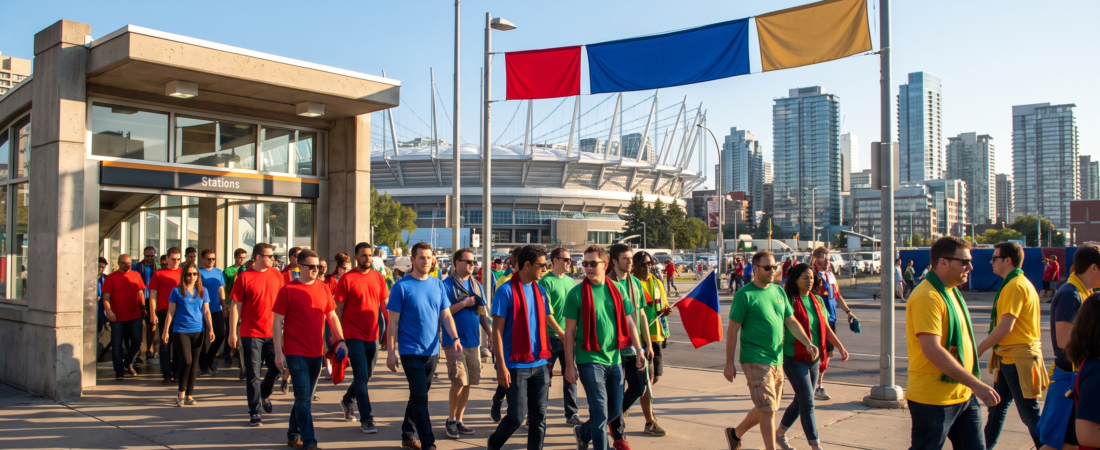
By ten in the morning the trains were already carrying people in red and green. This is my favourite hour of any match day – before the drinking, before the nerves, when it is mostly families and the slightly overexcited. Banners on the light poles, a brass band that had appointed itself, and strangers reading each other’s scarves like passports.
Midday: pick your neighbourhood, not the stadium
The mistake most first-timers make is going to the stadium too early. There is nothing to do outside a stadium for four hours except queue and spend money.
Instead, we found where the Moroccan community had gathered – which took one question to one person in a scarf – and spent the afternoon there. That is where the actual culture is: the food, the music, the grandmothers who have opinions about the starting eleven, the kids doing face paint on a folding table.
I ended up with a red-green stripe painted down one cheek by a woman who did not ask whether I wanted it and was entirely correct not to.
Late afternoon: the walk in
Go early enough to walk the last stretch on foot rather than arrive by car. The approach is part of it: the crowd thickening, the drums starting, the flags going up, the moment where separate groups of people become one crowd moving in one direction.
Security is airport-standard and slow. Clear bag rules are strictly enforced and vary by venue – check your specific stadium the night before, because I watched a lot of people abandon perfectly good bags in a bin.
The match: watch the stands
This is the advice I would give anyone who is not primarily a football person. Watch the crowd as much as the pitch. The noise is choreographed by people you cannot see. A section starts something, it travels, and forty thousand people join a rhythm nobody announced. When the goal came, the entire tier moved – physically moved – and I have never been in a building that did that before.
After: stay out
The temptation is to rush for the train. Do not. The half hour after everyone spills out is the best half hour of the day: the singing in the concourse, the scarves held up in the street, the strangers who want to talk to you because you were there too. We joined a chant on a street corner with the city lights coming on, and that is the clip I still watch back.
Then, yes, the train home at midnight is character-building. Budget an hour more than seems necessary and make peace with it.
What I would do differently
- Eat before the stadium. Stadium food is fine and costs four times what the neighbourhood does.
- Bring a portable battery. A full match day drains a phone completely, and you need it for the way home.
- Wear plain colours, not a replica shirt. Cheaper, cooler, and you can support anybody. I supported five different countries over the tournament and never had to buy a thing.
- Learn two words of the chant. People will teach you instantly and enthusiastically if you ask.
- Look up on the way in. That is the whole reason you came.
Questions I get asked most
Was it worth the ticket price?
For one match, yes, once. For a whole tournament, no – I would spend that money on more cities and watch the rest at fan festivals.
Is it fun without a team?
That is how I did most of it. Pick a country in the morning, commit fully, and by kick-off you will genuinely care. This is not cynical; it is the actual mechanism by which people become fans.
Was Coco there?
No, and she has not forgiven me. Stadiums are no place for a small dog, and eighty thousand people is not her audience – she prefers a Spanish square where she can be individually admired.
Keep exploring: the full World Cup 2026 guide, the tournament in full, and – since I was wearing their colours – Morocco.
— Lina