Almost every question I get about Morocco is one of four: when should I go, how much will it cost, is it safe for women, and what will I accidentally do wrong. Here are honest answers, from someone who arrived overconfident and was gently corrected by approximately forty people.
When to go
Morocco is not one climate. It is a coast, a desert, and two mountain ranges, and they disagree with each other constantly.
- March to May – the best window overall. Wildflowers in the Atlas, warm days in Marrakech, comfortable desert nights, and the coast not yet windy. Ramadan may fall here; see below.
- June to August – Marrakech and Fez routinely pass 40°C and the medinas empty out by noon. The Atlantic coast, though, is glorious: Essaouira and Tangier stay mild, which is exactly why Moroccan families head there. Mountains are pleasant.
- September to November – the second sweet spot, and my favourite. Warm sea, cooling cities, harvest in the countryside, calmer wind in Essaouira.
- December to February – bright cold days, genuinely cold nights, snow in the Atlas and skiing at Oukaimeden. Riads are built to shed heat, not hold it, so pack a warmer layer than the forecast suggests. Fewer crowds, lower prices, beautiful light.
Travelling during Ramadan
Ramadan moves roughly eleven days earlier each year. Visiting is entirely possible and often wonderful – the nightly iftar is an extraordinary thing to be invited to – but daytime rhythms change: some restaurants close, energy dips in the afternoon, and eating, drinking or smoking in the street is impolite. Everything reopens after sunset and the cities come alive.
What it costs
Morocco stretches almost any budget, which is one of its great pleasures. The currency is the dirham (MAD), it is a closed currency, and you generally get it on arrival rather than at home.
- Street food and cafes cost very little: a bowl of harira, a plate of grilled sardines, a mint tea. This is also where much of the best eating happens.
- A lovely riad usually costs less than a comparable European boutique hotel, and the range between a simple guesthouse and a palatial one is enormous – decide which nights deserve the splurge.
- Trains are excellent value, including the high-speed Al Boraq between Tangier, Rabat and Casablanca. Buses (CTM and Supratours) cover everywhere the train does not.
- Cash rules. Cards work in riads, bigger restaurants and supermarkets. The souks, the carts, the taxis and every tip run on dirhams – in small notes if you can manage it.
- Tipping is expected but modest: a few dirhams for a cafe, rounding up a taxi, more for a guide who genuinely worked.
Getting around
Trains are the easy backbone of the north and the coast. For the mountains, the desert and the small towns, you want a hired car, a grand taxi (a shared long-distance car that leaves when full), or a driver. Petit taxis work within cities – insist on the meter or agree the price first.
Driving is fine on the main roads and interesting in the mountains. Two warnings: police speed checks are frequent and scrupulous, and city medinas are simply not reachable by car. Have your riad arrange a pickup at least on arrival; a person who knows the alleys beats any app.
Etiquette that actually matters
- Dress. Cover shoulders and knees, in both directions of the gender line. This is a comfort measure as much as a respect one – loose long clothing is cooler.
- Ask before photographing people. Some decline, some expect a coin. A smile, a raised eyebrow and a lifted camera works in any language.
- Right hand for food and greeting. Bread is torn, not cut, and often by several hands at once.
- Accept the tea. Refusing food and drink is the most reliable way to cause quiet offence. Three glasses is the traditional sequence, and each is poured stronger than the last.
- Active mosques are closed to non-Muslims, with the notable exception of the Hassan II Mosque in Casablanca. Madrasas and museums are open to everyone.
- Fridays slacken around midday prayers; some workshops close. Plan a garden or a long lunch.
- Two words minimum: salam (hello) and shukran (thank you). Add la, shukran – no, thank you – and you have the whole toolkit.
Haggling, hustle and saying no
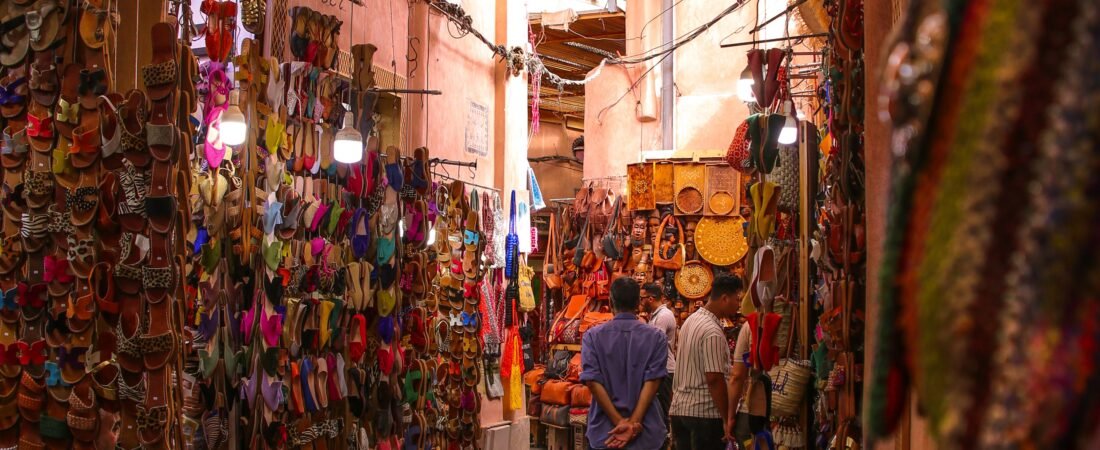
Bargaining in the souks is a social ritual, not combat. Counter at around a third of the opening price, climb slowly, keep it warm and funny, and walk away if the number will not come to you – which is often when it does. Browse all week, buy on the last day, once you know the fair price of a lantern to the dirham. And buy where things are made: the medinas still have working workshops, and watching a lantern being hammered out is worth more than the lantern.
Unofficial “guides” who insist a street is closed and offer to lead you elsewhere are the standard hustle. The street is not closed. A polite, firm la, shukran on repeat works. The hustle is commerce, not menace.
Is Morocco safe for solo women?
I travelled large parts of it as a woman with a small dog and a camera, and I would do it again tomorrow. Serious trouble involving visitors is rare. What you will get is attention: comments, persistent shopkeepers, the occasional follower in the medina.
What helped: dressing modestly, walking with visible purpose, wearing sunglasses, declining without engaging or explaining, taking lit and busy routes at night, and letting the riad arrange evening taxis. Booking a guesthouse with women on staff makes a real difference to how supported you feel. Say yes to invitations that come through a person you know – a riad owner, a guide, a friend of a friend – and be wary of ones that come from a stranger in the street.
Travelling with a dog
Coco has opinions about this. Morocco is broadly warm to small dogs – she was fussed over relentlessly – but it is not a pet-friendly country in the European sense. Many riads accept dogs, most restaurants do not mind an outdoor table, and public transport is inconsistent. You need an EU-style pet passport or health certificate and a rabies vaccination; check the current requirements before you book anything, because they change.
How long do you need?
- 4–5 days: Marrakech plus Essaouira, or Fez alone.
- 7–10 days: a proper loop – Marrakech, the desert, and back through the Atlas; or the north: Tangier, Chefchaouen, Fez.
- 2 weeks: both halves of the country, at a pace that lets you sit down.
Whatever you pick, build in fewer places than you want to. Morocco rewards staying put – the invitations only arrive once people have seen you twice.
Keep exploring: the full Morocco destination guide, Marrakech for first-timers, and what to eat while you are there.
— Lina